
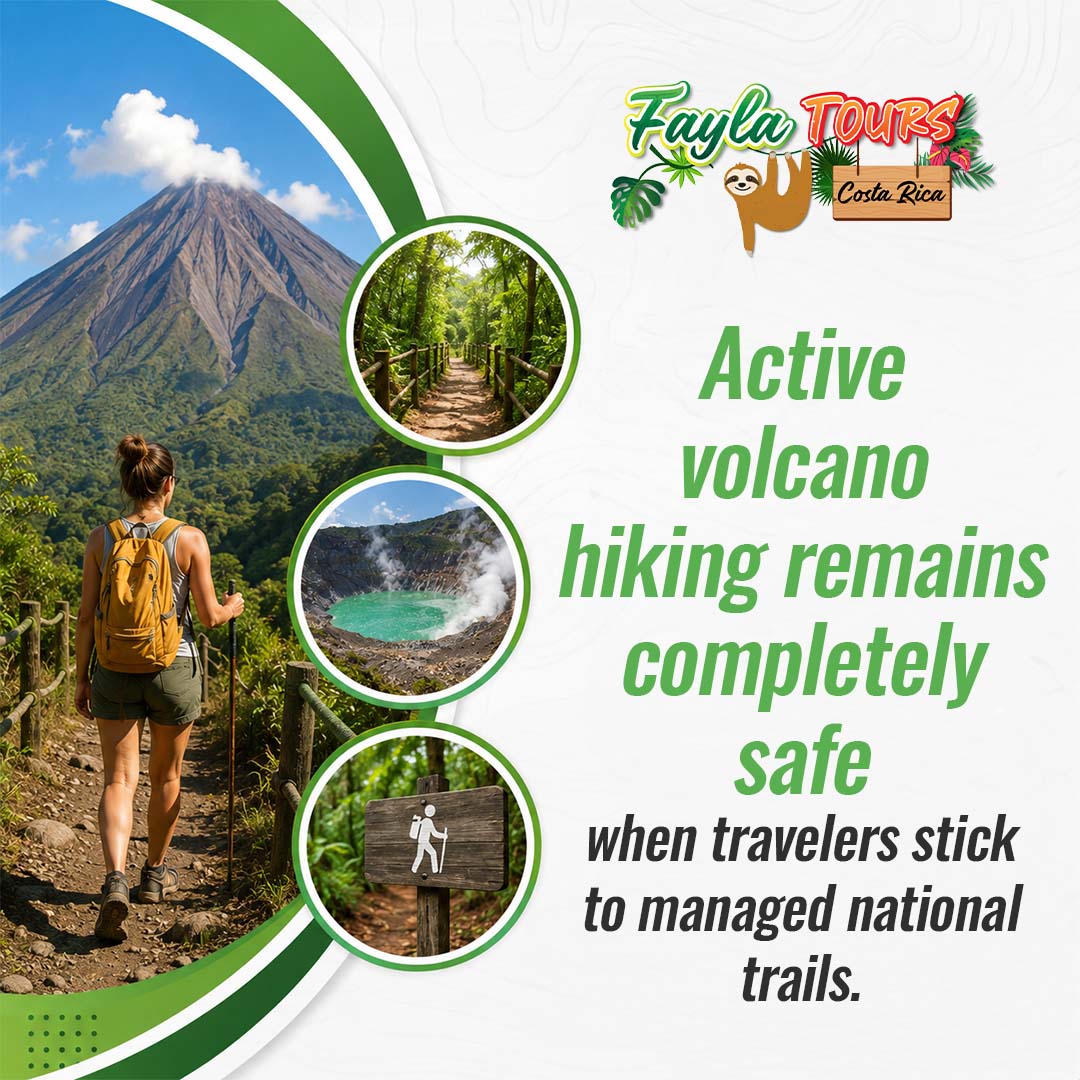
Yes, hiking near an active volcano in Costa Rica is safe when the route stays inside a managed national park, follows marked trails, and runs with a licensed guide. Costa Rica Fayla Tours, an airport transportation service in Liberia, Costa Rica, leads groups through exactly those conditions on every volcano hike, including the routes near Rincón de la Vieja and Miravalles.
What Safety Measures Are in Place on Guided Volcano Hikes?
Access to the active crater zones is restricted to designated trails that park rangers monitor and close the moment conditions shift. Our guides carry radios, know the terrain by heart, and set the pace around each group’s fitness level instead of pushing a fixed schedule. Every guide also carries basic first aid supplies and stays within radio range of the ranger station for the full length of the hike.
At Costa Rica Fayla Tours, every volcano excursion travels with a bilingual guide, and the day starts with our own airport transfers from Guanacaste in Costa Rica, so a driver who already knows the local roads gets guests to the trailhead safely before the hike even begins.
Which Volcanoes Are Open for Hiking Right Now?
The secondary craters at Rincón de la Vieja and Miravalles stay open to guided hikers, while the primary craters at both sites remain off limits to the public because of ongoing volcanic activity. That boundary is what allows the hike to feel adventurous without placing anyone inside the real hazard zone. Guests who arrange their Guanacaste airport shuttle service through the same operator handling the tour tend to get trail-status updates straight from one point of contact, since park access can change on short notice depending on seasonal conditions.
What About Eruption Risk?
Rincón de la Vieja has produced minor eruptive activity in recent years, most notably in 2017, and Costa Rican monitoring agencies such as OVSICORI-UNA track seismic and gas readings around the clock using seismic stations and gas sensors positioned across the volcano’s flanks.
We adjust or cancel routes on short notice whenever a monitoring agency raises an alert, which is part of why booking through an established operator carries real weight compared to showing up independently.
Minor phreatic eruptions, small bursts of steam and ash, are the most common events at this volcano and rarely affect the lower trail sections used for guided hikes, though guides still watch conditions closely before every departure.

How Does Costa Rica Fayla Tours Support a Safe Hike?
Every group we guide travels with air-conditioned transportation, a leader familiar with current trail conditions, and a pace that never rushes the crater zone. Travelers comparing a Costa Rican airport shuttle in Guanacaste before booking a volcano hike usually find that pairing the transfer and the tour with one operator keeps both pieces on the same fixed schedule, with no surprise charges if a route needs adjusting for conditions on the day.
Travelers planning a volcano day in Guanacaste can contact Costa Rica Fayla Tours via WhatsApp at (506) 8797-1515, call at 011 (506) 7202-7500, or email info@costaricafaylatours.com to check current trail conditions, book a guided tour, or arrange Liberia Airport shuttle services for convenient transportation to and from their destination.